In what seems a lifetime ago, but really was only two years, I spent a careless morning strolling through London. I recall glancing into a gallery between St. James Square and Piccadilly--one of many on a street full of vendors of reputable old master paintings--when I was struck with an odd sense of recognition. Centered in its display window was a small floral still life in an elaborate gilt frame. The work was identified as being by Bartolomeo Ligozzi (1630-1695), an Italian painter of no remarkable importance, except that he was highly regarded throughout the seventeenth-century for depictions of brightly colored flowers. Often Ligozzi painted these blooms in vases set upon stone slabs, but in otherwise shallow, dark pictorial spaces. I stood in front of the window for what must have been a while studying the work. I took a picture with my cell phone. I committed the name of the artist to memory and thought to myself that I needed to do some follow-up research. I went to a meeting and promptly forgot about the encounter.
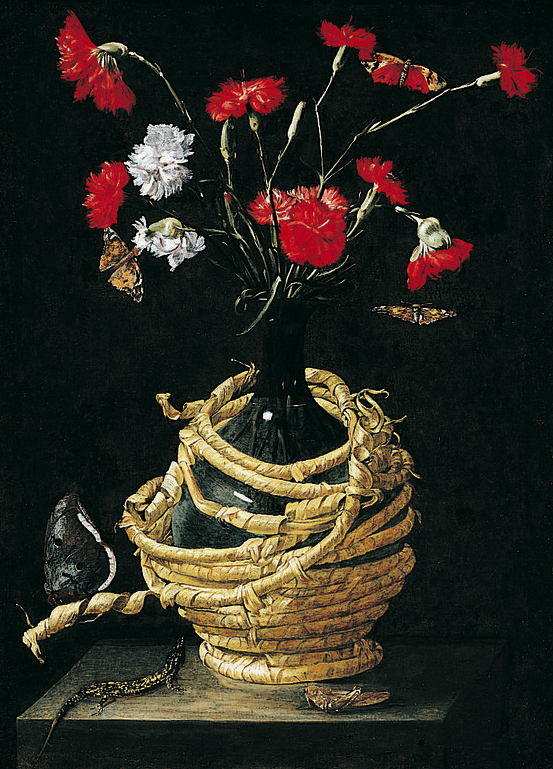
Sometime after I returned to my work in San Diego, I showed the cellphone image taken in London to an intern who was then assisting the Timken with organization of our curatorial files. The image was too full of reflections on the plate glass to convince her of what I had been thinking: “could this work be by the same artist who created the still life of flowers in a bottle at our museum?” Many attributions have been offered for that picture since it arrived at the museum in 1971. At first, some scholars hoped that it might be by Michelangelo Merisi da Caravaggio (1571-1610), or, more likely, by one of his followers, such as Guido Cagnacci (1601-1663). Why not Ligozzi, then? Sometimes settling questions about attribution is best done through the process of elimination. If we have no clear idea who was responsible for making a particular image--and in this case, we really didn’t--it is nonetheless helpful to rule out the names of artists who could not have done it.
In spite of the fact that we no longer know who made it, the Timken’s still life is painted with an indisputably charming naivete. Like the painting I studied from the sidewalk in London, it is lit from the left side. Stems of red and white carnations erupt in all directions from a low-necked glass wine bottle whose protective raffia covering is in the process of unraveling in a loose spiral. Our painting also includes depictions of several butterflies, a grasshopper, and a spotted lizard sprawled lengthwise across the grey shelf that supports the whole ensemble. That lizard cranes its neck up toward the bouquet above it, testifying to the artist’s skills at creating convincing, illusionistic detail. Depictions of insects and reptiles are staples of baroque still life practice, especially in Northern Europe. That iconography appears slightly less often in Italian work of the same moment, but it is not unheard of there, either. Comparisons between the Timken picture have been made to other early 17th-century works--for example the Museum of Fine Arts, Boston’s Poppies in a Wine Flask (https://collections.mfa.org/objects/33397/poppies-in-a-wine-flask?ctx=eff4655e-2825-4f86-b9f3-7b8c4e363898&idx=0) which shows similarly disordered bunches flowers and torn coils of raffia, but has no critters to speak of. At one time in its past, Boston’s painting was once attributed to Caravaggio. Today the artist is listed as unknown, although one scholar recently suggested Tommaso Salini (c. 1575-1625) as a possible maker.
I haven’t given up on our little painting, or the possibility of someday learning the name of its maker. If not Ligozzi (or Salini), then who? Careful analysis and comparison--the process of elimination at work--might clinch an identification. Or, this might happen by chance--something glimpsed while passing on the street, or on the wall of a museum, might lead to revelation. In any case, let’s just hope that the process doesn’t take another 50 years.





.png)