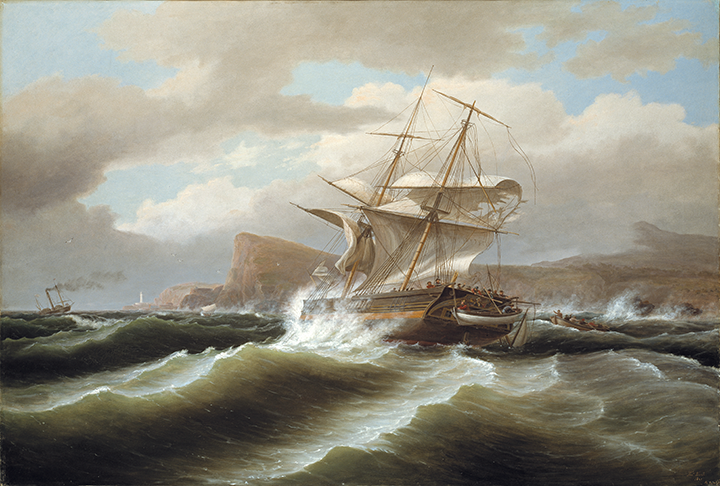
A truism of art history has it that any painted ship is also always a representation of the “ship of state.” For the British-born artist, Thomas Birch (1779-1851), that seems to have been a durable trope, one that served him throughout a successful career as a maritime painter. His father, William Russell Birch (1755-1834) was also an artist. Together, they set up shop in Philadelphia where they specialized in making engraved views of the city shortly after moving to the United States, in 1794. By the early 1800s, Thomas Birch began working independently of the family business and earned a modest reputation for the topographical landscapes he created of the Pennsylvania countryside. He is said to have painted at least 500 images throughout his career, the majority of them seascapes. Particularly after taking a trip up the Delaware River, in 1805, Birch became enamored of maritime subject matter which he imbued with an experienced sailor’s sense of accuracy. Eventually, he was considered to be a premier “portraitist” of American naval vessels, and battles, during the early 19th century.
While shipwrecks have fascinated Western artists since the Renaissance, Birch seems to have been mostly inspired by Baroque approaches to this sub-genre. Compositions like his Loss of the Schooner ‘John S. Spence’ of Norfolk Virginia, 1833 (LACMA) and the Timken’s American Ship in Distress, painted almost a decade later, are reminiscent of the dramatic and often large-scale images produced during the so-called Golden Age of Dutch painting by the likes of Simon de Vlieger (1601-1653) Ludolf Backhuysen (1631-1708), and Willem van de Velde (1633-1707). Birch balanced his depictions of heroic seamanship with careful attention to the rigging of sails and close observation of weather conditions to create a modern maritime idiom that appealed to collectors in the United States.
The War of 1812, which was itself triggered by disputes over maritime rights, was a source of inspiration for many American artists. Britain had been, up until that time, the greatest naval power in the world, but the United States’ much smaller Armada proved to be a worthy adversary to the much larger and better-equipped British fleet. For Birch, who was born in the Midlands of England, the topic of naval warfare between his home and adopted countries must have sparked conflicted feelings. A big canvas like American Ship in Distress remains vague about its maker’s commitments, except that the work is about being in a state of distress. The picture shows a vessel which has sustained significant damage to its main mast and, adrift in turbulent waters, is in the process of being abandoned by its crew. It is impossible to identify the ship with certainty--the name is effaced--but a depiction of George Washington and a flag on its stern serve to clinch its probable identity as an American warship. Michael Quick has argued that the distant coastline resembles England and that the boats that come to its rescue are likely British, too. If so, Birch might be assumed to give patriotic preference to his British roots in this invented image of risk on the open water.
An American Ship in Distress was acquired by the Putnam Foundation in 1973. Except for the scholarly entries written in the Timken’s 1983 and 1996 collection catalogues, surprisingly little research has been published about the painting. Birch’s picture counts among several noteworthy seascapes in the permanent collection--Fitz Henry Lane’s Castine Harbor and Town, 1851 (see Work of the Week #10) and Claude-Joseph Vernet’s A Seaport at Sunset, 1749 (Work of the Week #36) both hang nearby. These views of ships and harbors provide us with insights into the concerns of maritime painters over a period that stretched from the 1740s to the 1850s and the complex political claims of their time.





.png)