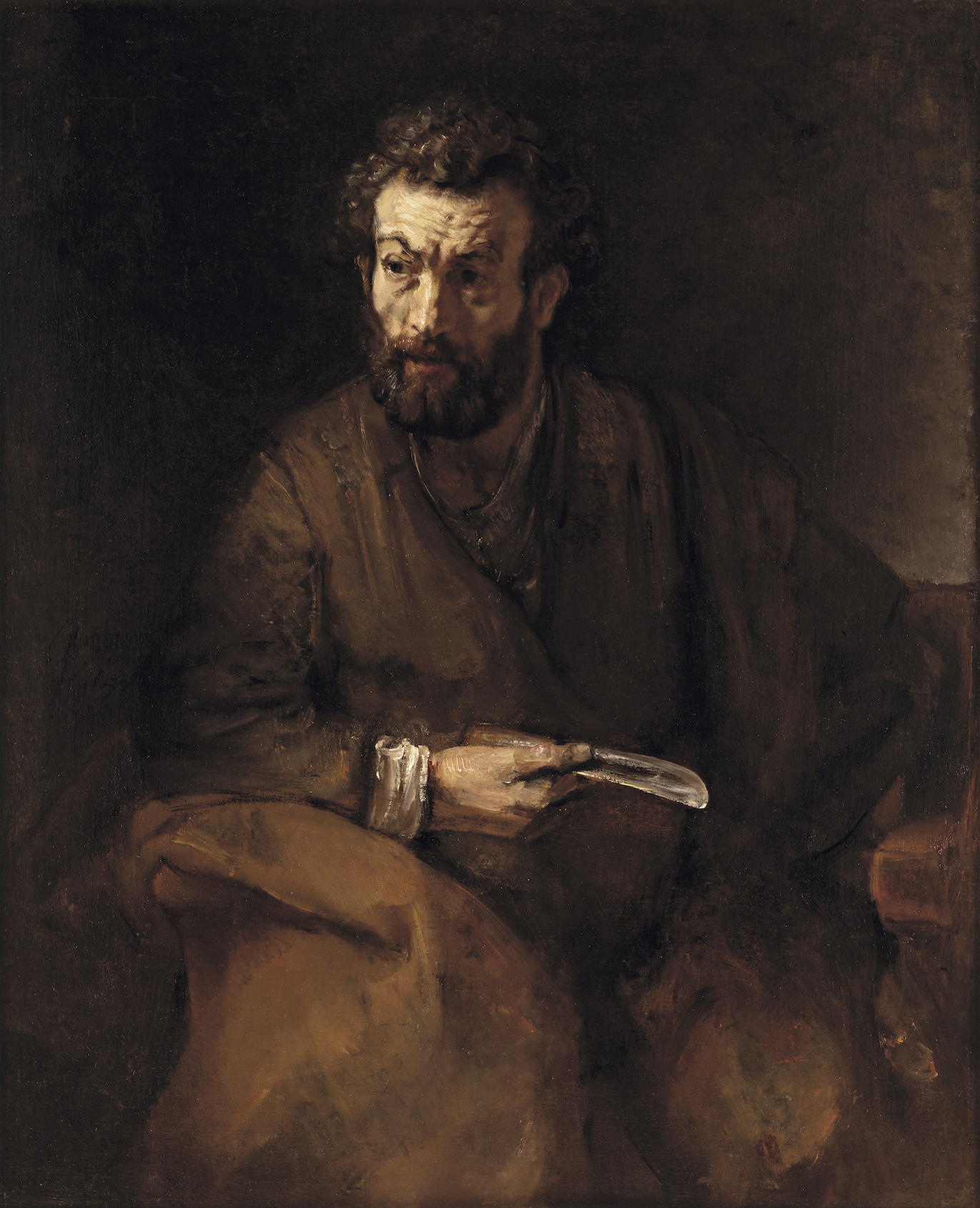
Ever since the Putnam Foundation acquired a major work by Rembrandt van Rijn (1606-1669), in 1952, stewards of the 17th-century masterpiece have been keenly aware of how people from across the globe flock to it. Without overdramatizing, St. Bartholomew serves as a pilgrimage destination for devotees of the artist. The large image is, after all, the only authentic oil painting by Rembrandt in San Diego, and one of just 14 paintings by him in Southern California according to the scholars who know these things (https://mk0rembrandtins14vr1.kinstacdn.com/wp-content/uploads/2019/05/Rembrandt-In-Southern-California-Exhibition-Guide-v7.pdf. ) Although the Timken has been closed to the public for almost a year now, the museum has felt a responsibility to ensure that museum visitors have access to Saint Bartholomew, whenever it is possible. To this end, several months ago, we worked with our colleagues at the San Diego Museum of Art to install the painting in their European galleries while the Timken took advantage of its closure to perform some facility improvements. The pandemic vexed even that effort to share. For my part, I’ve postponed writing about this image in this space for almost a year, anticipating the chance to use my “Work of the Week” forum to celebrate Saint Bartholomew’s reinstallation in our galleries.
We don’t know precisely when that will happen, but an end is in sight. Public health guidelines permitting, the museum will likely reopen--magnificently refreshed--later this year. Rembrandt’s painting calls us back from any despondency about delays, however. At his best, as he was when painting St. Bartholomew, the artist was masterful at representing complex states of mind. Leaning forward in a slightly inquisitive manner, the bearded figure in this dark composition seems to ask: “What makes you think you’ve got it bad?” As if in response to his own question, he holds in his right hand a broad, steel blade that references his own martyrdom: Bartholomew was skinned alive. Pointedly (no pun intended), the knife itself reflects an exterior light source, glinting near the image’s center. It is a curious fact about this work that, at one point in its history, a squeamish owner eliminated the knife by having a book painted over it. Thankfully, conservators were able to remove that overpainting without leaving a trace. We should remember that images like this one had precise, didactic purposes. Beyond showing off the artist’s bravura brushwork and his uncanny ability to conjure realist effects, St. Bartholomew’s expressive impact depends on our appreciation of the Saint’s refusal to give in to, or even register personal despair. He remains stoic and utterly convinced of his role in spreading the gospel throughout the world. If we feel disillusioned about the state of things today, just consider St. Bartholomew. Rembrandt puts him on the edge of his seat, poised to spring into action, and visibly unconcerned about whatever fate brings his way. By way of contrast, let’s consider a slightly earlier treatment of the Saint’s iconography, by Jusepe de Ribera (c. 1591-1652) (https://www.museunacional.cat/en/colleccio/martyrdom-saint-bartholomew/josep-de-ribera-o-jusepe-de-ribera-dit-lo-spagnoletto/024162-000 ). In that dramatic, Spanish work, Bartholomew is shown near the beginning of his torment. His physical suffering is palpable as, upside-down, he gazes imploringly back at the spectator. Eschewing the principle of calling for empathy with the martyr, Rembrandt instead offers the firmly seated figure as a source of almost professorial wisdom. Bartholomew’s furrowed brow suggests that he is thoughtfully engaged with the present. Even though he recognizes things aren’t going well for him, he won’t be thwarted from his higher purpose. Let’s take courage from Rembrandt’s example. Emerging from darkness, there is reason to remain hopeful and alert.





.png)