Pictures can be puzzles, some more obviously than others.
Think of The Ambassadors by Hans Holbein the Younger (1497/98-1548). Standing before that monumental, nearly square portrait of two young men, we cannot avoid staring quizzically at the conspicuous, strangely elongated, grey form that hovers in the immediate foreground. This puzzling shape is just one of several rebus-like elements that the artist introduced to his large composition. When viewed from a steeply oblique angle, the anamorphic grey form resolves into the depiction of a skull, an emblem that overlays the entire scene with ominous dread. The two prosperous figures that flank the skull--ambassadors from France to the court of Henry VIII--may be surrounded by accumulated signs of knowledge but, like everyone else, they are destined to die. Holbein’s is a satisfying, if dismaying, puzzle to solve. I never visit the National Gallery in London without stopping in front of his masterwork for at least a short while to marvel at its pictorial invention and to ponder its maker’s lasting message about the ends of cultured experience.
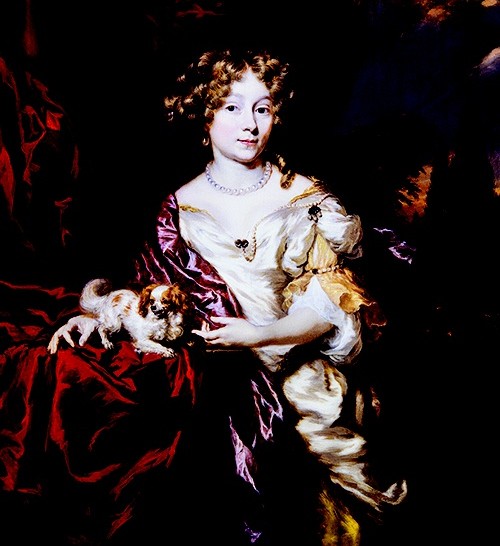
The Timken has its own share of puzzling paintings that promise rewards if resolved. One example: I have spent a lot of time wondering about a small picture in our Dutch/Flemish gallery that is presumed to be the work of Nicolaes Maes (1634-1694). Portrait of a Lady was acquired by the Putnam Foundation as a gift, in 1986. The museum counts a few gifts in its permanent collection, but most of the works were purchased either by the Putnam sisters or else by the museum’s leadership in keeping with a strategic vision to bring the best possible representations to San Diego. Maes is a bit of an outlier. He was born in Dordrecht but moved to Amsterdam while still a teenager. Once there, he became a star pupil in the thriving workshop that Rembrandt van Rijn (1606-69) maintained. Maes started his career as a genre painter, producing scenes of everyday life for a burgeoning art market. By the 1670s, he shifted the focus of his practice to painting portraits of wealthy elites. Works such as his Portrait of Petronella Dubois, 1677 (Rijksmuseum), show off Maes’s skill at painting sitters surrounded by sumptuous materials and displaying natural expressions.
Scholars have speculated about the identity of the sitter in the Timken’s portrait, which remains a mystery. A few have argued that it could be a youthful portrait of Mary Stuart II, daughter of the Duke of York (King James II) and Anne Hyde, but without providing much convincing proof. If the date in the lower right corner of the painting is correct, Mary would have been fifteen years old at the time this work was completed. That date would further suggest that this particular portrait was done to commemorate Mary’s marriage to William of Orange, with whom she would eventually rule England, Scotland and Ireland. We know that Maes painted a pair of portraits of William and Mary around the same time (Blanton Museum of Art, Austin) but those depictions differ in that they are both smaller ovals and are bust-length. The Blanton’s Mary doesn’t look very much like the light-haired woman in the Timken’s picture. Ours better resembles a slightly larger work by Maes known as Portrait of a Lady as Diana (art market) which once belonged to the Dutch royal family. Both that picture and the one in San Diego feature the same woman with blonde curls and smiling face.
Puzzling over these resemblances sent me back to our curatorial records. Maes’s painting appeared in two early auctions. The first was held from July 26th to August 16th 1859, at which the entire contents of “Lord Northwick’s Extensive and Magnificent Collection of Ancient and Modern Pictures” were offered to the public in London. Indeed, Baron Northwick (born John Rushout) was a great collector who, among many other works, owned a portrait of the Duke of Orange. But lot #1791 in his estate describes a “Portrait of a Princess of the House of Orange, with a Dog.” The catalogue identifies the artist responsible for this painting as “G. Netscher,” not Maes. Caspar Netscher (1639-1684)--also known as Gaspard Netscher--was Maes’s contemporary who lived in the Hague. Netscher specialized in portraits of well-to-do women placed against dramatic backgrounds, as well. A second record of the Timken’s painting appears almost a half-century later, in 1907. By that time the work belonged to the Massey-Mainwaring Collection, which was dispersed by Messrs. Christie, Manson & Woods “at their great rooms” on St. James Square over a six-day period. The auction catalogue includes a reference to the picture as lot #17. “Portrait of a Princess of the House of Orange,” now attributed definitively to Nicolaes Maes, is described as follows:
Small, three-quarter figure, standing in front; her right arm rests on a table, on which is a small spaniel; a column and red curtain in the right background, landscape on the left. Signed and dated 1677.
This seems to be a match to the picture in San Diego. Annotations in the catalogue margins suggest that the painting sold on March 16, 1907 for £183.15. Its provenance is listed there, too: “From the Northwick Collection.” For me, the failure of both British auction houses to identify the sitter as Mary Stuart is surprising. She was the Queen after all. Could this be another female member of the House of Orange, then? I also wonder under what circumstances did this Portrait of a Princess of the House of Orange, change attribution (and perhaps acquire a signature and date) between 1859 and 1907? Small puzzles, perhaps, but worth pondering if we hope to understand this work’s place in our collection, and in history.





.png)