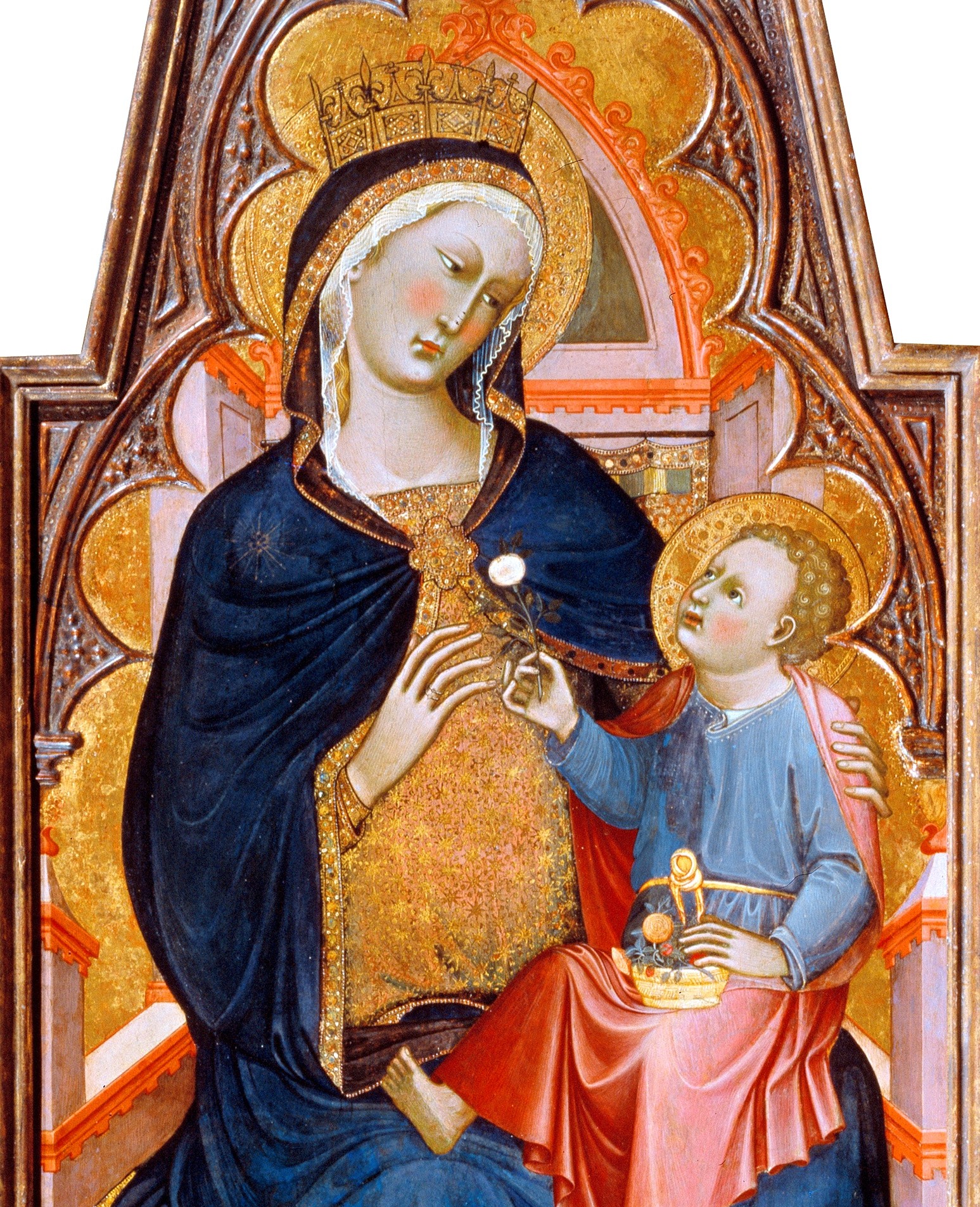
Acquired by the Putnam Foundation in 1998, Madonna and Child Enthroned is an imposing image. It needed to be. Originally it formed the central element in a highly elaborate altarpiece. Toward the end of the trecento (fourteenth century) the whole ensemble would have been found in the church of Santa Margherita, in Costalpino, on Siena’s periphery. Art historians are not certain exactly when, or why, the altarpiece was disassembled. In 1922, an Italian scholar named Ettore Romagnoli identified the panel, along with two others, and suggested they were likely painted by the same confident hand: Niccolò di Buonaccorso’s. Romangnoli argued that together these fragments once comprised the polyptych commissioned by the parish in Costalpino for a building that appears no longer to exist.
A depiction of St. Lawrence with Patrons also by Niccolò is now held by the Pinacoteca Nazionale in Siena. That tall vertical panel almost certainly formed another element in the polyptych that was organized around our Madonna and Child. It would have appeared to the right of our image. Yet another similarly-sized painting of St. Paul is today in the collection of the Metropolitan Museum of Art in New York. It could have belonged to this ensemble, too. Nothing is simple, however. The St. Lawrence in Siena at some point in its past was extensively repainted, and someone moved it to a nearby church, Sant’Andrea a Montecchio. This might have happened as early as the sixteenth century. Archival photographs at the Frick Collection show both the original and overpainted versions of the panel, enabling us to witness St. Lawrence’s transformation into St. Margaret. The elaborate, cinquefoil architectural framework that we know so well from the Timken display, remained perfectly intact all the while (https://www.frick.org/blogs/photoarchive/st_lawrence_recovered).
Niccolò di Buonaccorso (c. 1348-1388) was one of many sophisticated painters to emerge from Sienese culture in the late 1300s. Afterwards, he was judged a minor artist by some scholars of Renaissance painting. Why? In addition to this extraordinary example of his practice, we have another work of Niccolò’s at the Timken, the so-called Virgin of Humility (c. 1370-75, see Work of the Week #16). That little triptych underscores just how polyvalent this artist was. Both works include demonstrations of the artist’s investment in symbolism--the single white rose that Christ delivers to his mother’s elongated fingers is a sign of her purity--as well as ordinary reality--the sewing basket in the little triptych was meant to convey Mary’s mundane preoccupations. The presence of both large and small, public and private devotional images, each managed with nuance and control, shatters any presumption that this artist was somehow limited to producing just one kind of work.
The Timken mounted a small show of religious works produced in Niccolò’s orbit, back in 1998. Called Art and Devotion in Siena after 1350, the exhibition was curated by Pia Palladino. Palladino makes a strong case for the importance of San Diego’s triptych and altarpieces. Further research needs to be done, but connecting the group of smaller panels already attributed to the artist, a list that includes the Metropolitan Museum of Art’s The Lamentation of the Dead Christ (c. 1380-88), The National Gallery of London’s Marriage of the Virgin (c. 1380), and the Uffizi’s Presentation of the Virgin at the Temple (c. 1380), might someday help associate them with other, contemporaneous polyptychs. Such panels may have comprised parts of a single altarpiece’s predella, or base, or else they formed independent sacred works. These circumstances are also worth exploring even as we contemplate the lasting, satisfying immediacy of a work of art painted more than 630 years ago.





.png)