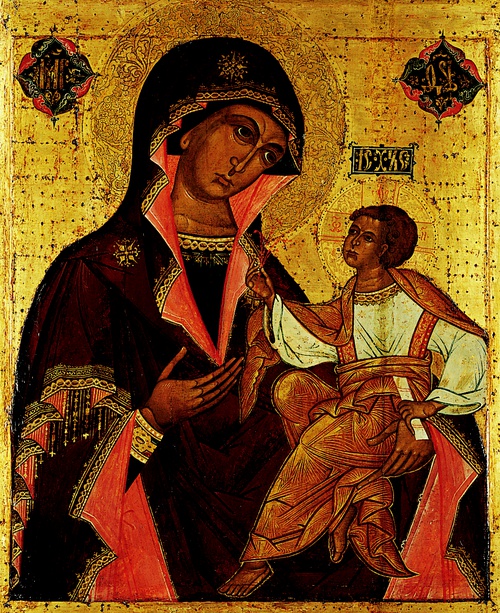
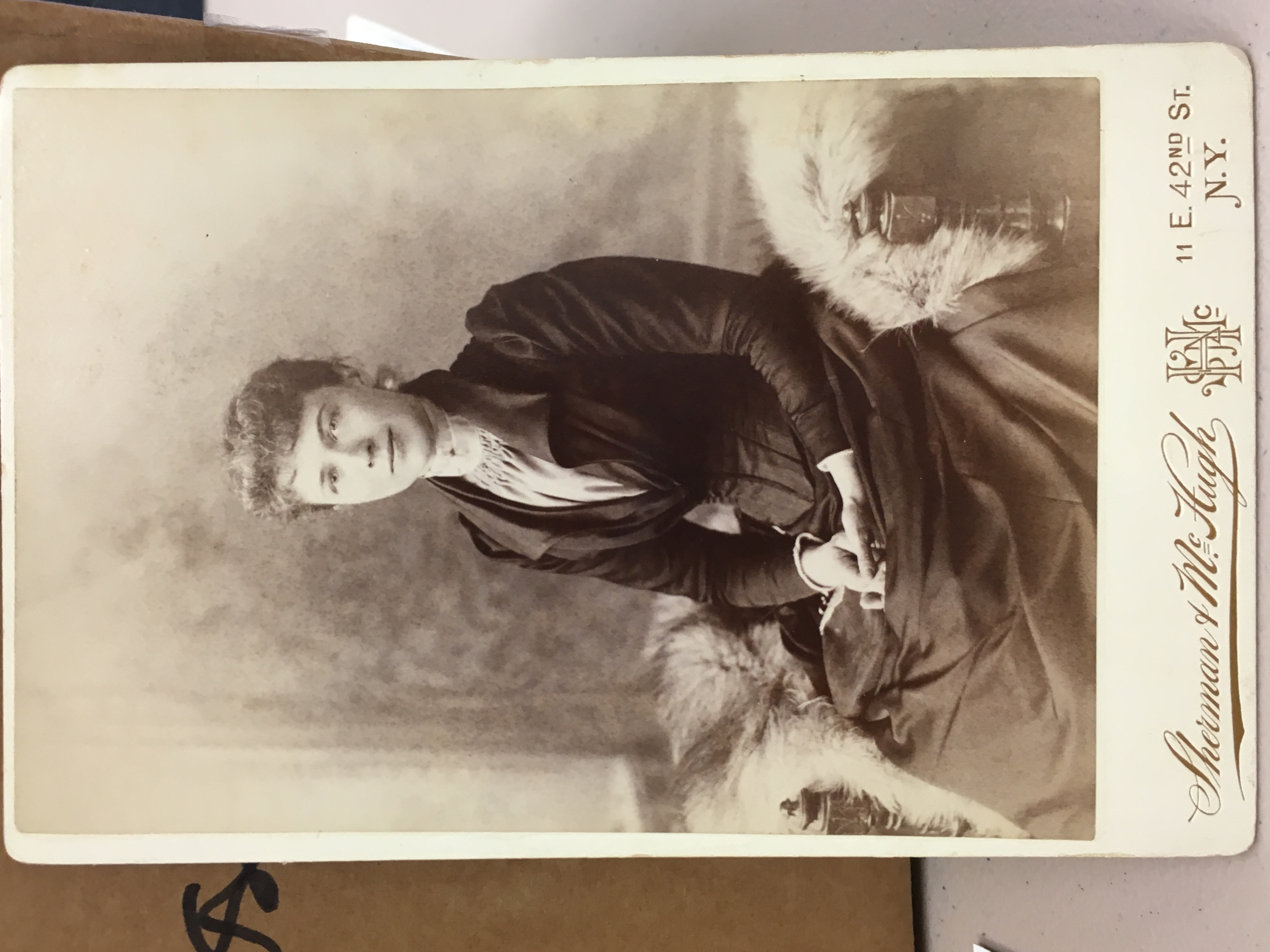
The Timken’s Russian icons tend to be small, a reflection of their still recent private devotional purpose within the Putnams’ family home. Amy Putnam (1874-1958) acquired one unusually large image, The Georgian Mother of God, shortly before the end of her life, at a time when the work’s ultimate destination within a museum must have already figured in her imagination. In 1969, when the first significant catalogue of the Timken’s holdings was published, small mention, and an exception, was made for the display of Amy Putnam’s beloved Russian works. “In only one gallery is there color on the walls,” Agnes Mongan wrote. “That is the gallery which contains a remarkable collection of icons.” Mongan, who mostly advised the museum on its French acquisitions, explained: “It is the one that will be catalogued later. The golden backgrounds of the icons glow against a soft-green cut-and-uncut Italian velvet woven specially for the gallery in Florence.”
Those of us who enjoy the Russian icon gallery at the Timken know that it recently underwent substantial renovation. Wendy Salmond, a scholar of Russian art who teaches at Chapman University, was invited to reinstall the icons in 2017. In that way, Salmond partly fulfilled Mongan’s prediction. The 2017 display included additional works that had long been in storage and introduced new, thematic groupings to the space. In Salmond’s interpretation of the works depicting the iconography of the Virgin with the infant Jesus, including The Georgian Mother of God, she explained that “Icons of Mary . . . were among the first holy images brought to Kiev from Constantinople,” and that “the most important of these were the Hodigitria (“she who shows the way”) in which Mary points to her child as the way of Salvation, and the Tenderness icon, expressing maternal love.”
The Byzantine roots of Orthodox Russian art are clearly expressed in this large panel. The stylized, angular bodies and patterned, striated draperies are reflections of the essential differences that separate the world we live in from the divine realm represented through these expressly religious works. The fact that we do not know the name of the artist who made this big, impressive image is also telling: the maker is insignificant in comparison to the subject matter, which is awesome and holy. As a demonstration of the Hodigitria--Mary showing us the way--The Georgian Mother of God is an especially compelling example. At the same time, this complex painting still captures the sweet emotional bond between mother and child that surely appealed to Amy Putnam, and to tens of thousands of visitors to the Timken each year.





.png)