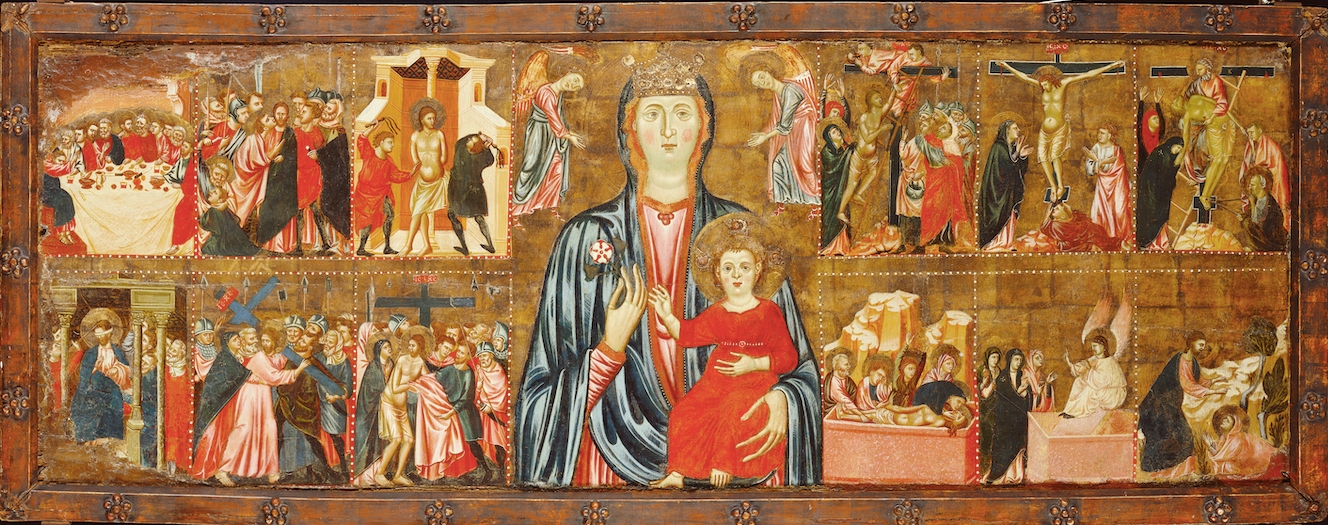
The oldest painting at the Timken Museum of Art is simultaneously one of its most delicate and mysterious. The work I am thinking of is a dossal--an ornamental image that was intended for display behind the altar of a church. Early on, devotional icons like this one were painted on fabric. During the Renaissance, however, they were more likely to be painted on wood panels and were precursors to increasingly elaborate altarpieces whose popularity spread throughout Europe. Scholars believe that this particular dossal was made in Florence. Less certainly, it seems to have been produced for the Augustinian convent of Santa Maria dei Candeli, founded in the early 14th century. That church was significantly enlarged in the 16th century and ceiling frescoes by Niccolo Lapi (1661-1732) and a new altarpiece by Carlo Sacconi (active 1692-1747) were added to it in the early 18th century. In the trecento (i.e., 1300s), however, Santa Maria dei Candeli must have been a small, austere space. If this dossal was present there at the beginning, it would have stood out as a resplendent image within an otherwise spare interior.
We have lost track of the name or, more likely the names, of those responsible for the Timken’s dossal. In an essay published in The Burlington Magazine in 1930, the San Francisco-born art historian George Martin Richter, likened it to known works by Meliore di Jacopo (act. 1239-1284) based on purely stylistic grounds. Richter suggested that the hand that painted this particular dossal belonged to a slightly later moment, however. Subsequent experts have concurred with Richter. The central depiction of Mary holding the infant Jesus in her lap and flanked by angels looks Medieval--flat, stylized, and heraldic in color. Precious stones were originally inlaid in Mary’s crown but these were removed long before the dossal ever came to San Diego, in 1967. Just imagine these jewels glinting near the composition’s middle whenever the dark, horizontal picture was illuminated. Twelve smaller scenes from the Passion surround the Virgin and Child. In contrast to the stiffer, more Medieval treatment of the central group, these images are highly animated and demonstrate their maker’s growing knowledge of perspective. As in the work of leading Florentine artists of the trecento, such as Giotto (1266?-1337), bodies and spaces in these subsidiary rectangles are treated more volumetrically as the artist struggled to represent the world in three dimensions.
How can we make sense of such contrasting approaches within the same work of art? It seems likely that more than one artist could have worked on the Timken’s dossal. This would explain the difference in treatment between the central image of the Virgin and Child and the flanking scenes. It was not unusual for artists to collaborate in this era. They often worked together in allied workshops. Some scholars have speculated that the dossal was begun in the late-13th century by one artist, who presumably died, only to be finished in the early-14th century by another. Anne Derbes, in a 1996 book about Passion iconography in early Italian art, associated the Timken dossal with the names of two little-known artists: the so-called Master of the Magdalen (active 1265-1290) and the Master of San Gaggio (active 1300). Such an explanation rationalizes the divergent pictorial strategies employed in the center and sides of the same work. Careful scientific analysis might suggest firmer answers. For the time being, recognizing this multiple authorship goes a long way toward making sense of the work’s divided appearance.
Further complicating this puzzling situation, our image has been transferred from one support to another. We think this happened in the 18th century and, if so, that would roughly coincide with the renovations that took place at Santa Maria dei Candeli. The effort to preserve the painting--already 400 years old--by mounting it on a fresh wooden panel was accompanied by the appearance of a new inscription: an 18th-century text on the back of the work identified the dossal as a gift of the Capponi family. Francesca Teresa Capponi (1705-1775) was the abbess of the Augustinian convent of Santa Maria dei Candeli. The same inscription attributes the picture to Cimabue (c. 1240-bef. 1302) who, in addition to being Giotto’s teacher, is typically given credit for having inaugurated many pathbreaking pictorial conventions of the Renaissance. Today, no one thinks the inscription is accurate, but it underscores the hopefulness that surrounds this--and so many other--important devotional works of the trecento.





.png)