Landscapes make complex statements about the places they depict. In the Timken’s American gallery, the depictions are by the major contributors to this genre: George Inness (1825-1894), Albert Bierstadt (1830-1902), Thomas Moran (1837-1926), and Jasper Francis Cropsey (1823-1900). Together with Thomas Cole (1801-1948), Asher B. Durand (1796-1886), and Frederic Edwin Church (1826-1900), these artists suggested the principal directions for landscape practice in the United States that were closely followed by later practitioners. Cole and Church may have led the way in venturing up the Hudson River Valley to paint its relatively unspoiled vistas, but they were quickly followed by the likes of Cropsey and others.
The so-called Hudson River School painters are best known for their large-scale, dramatic depictions of conspicuously American scenery: Niagara Falls, the Rocky Mountains, and Yosemite, among other sites beyond the Catskills. These intrepid artists’ decision to record--oftentimes hyperbolically--the natural wonders of the United States became synonymous with elevated ideas about divinely ordained beauty as well as national doctrines of westward expansion and colonization. Painters like Bierstadt and Moran traveled West and, indeed, did not stop until they reached the Pacific Coast. Cropsey traveled to Europe on a couple of occasions--the first time was in 1847 when he took over Thomas Cole’s studio in Rome--but he seems only to have traveled as far West as Wyoming on the North American continent. The artist’s mature work reflects his taste for vistas informed by European attitudes toward the sublime, albeit matched to the settled splendor of the Mid-Atlantic region.
Cropsey was raised in a devoutly Christian family on a farm on Staten Island. He pursued an architectural career before committing himself fully to painting. In 1843, at age 21, Cropsey became the youngest member to be named an Associate of the National Academy of Design, achieving renown both as an exhibiting artist and as a teacher. His detailed observations and theatrical compositions earned him comparisons to contemporaries in England, such as the Pre-Raphaelites. This identification is not very surprising. Cropsey and his wife, the artist Maria Cooley (1828-1906), lived in London from roughly 1856 to 1863 where they befriended John Ruskin and others associated with that ultra-realist movement. Even while living abroad, however, he continued to paint subjects based in his memories of the American countryside. Large paintings like Autumn--On the Hudson River, 1861 (National Gallery of Art) were exhibited in England to much critical acclaim.
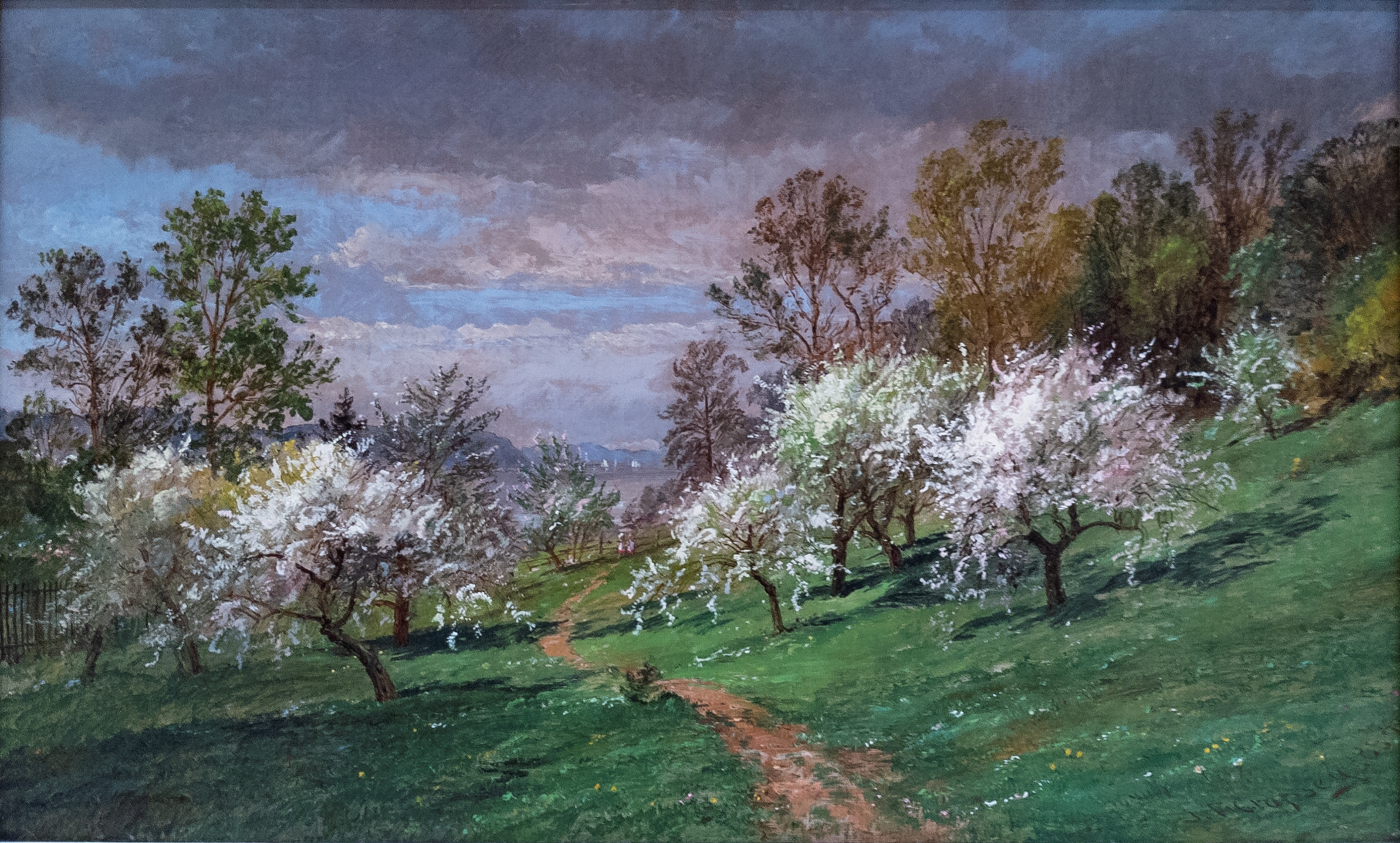
Later in life, having attained significant commercial and personal success, Cropsey opted to paint in a less obviously theatrical style. Sketches like the Timken’s Apple Blossoms belong to this moment in the artist’s long career. Our small picture shows the landscape near Cropsey’s home in Hastings-on-Hudson. The image conjures the glory that springtime offers rural communities without exaggeration or any invented effects. A footpath splits the composition’s verdant foreground in two and leads the spectator’s eye through a rustic apple orchard. Beyond the blossoming trees, a pair of figures can be seen walking together and, further on, we glimpse the Hudson River with its boats and hills beyond. It is a simple, harmonious scene, like many others from this period in the artist’s life, and markedly different from the spiritually-informed emotionality of his best-known works.





.png)