George Inness (1825-1894) was born along the Hudson River, just below Poughkeepsie, but was raised in Newark, New Jersey. Despite his proximity to New York, Inness received hardly any formal training as a painter. Instead, he was hired as an engraver of popular reproductions by Nathaniel Currier (1813-1888), whose partnership with James Merritt Ives (1824-1895) resulted in one of the most prolific print publishing businesses in American history. Working for Currier and Ives, the young artist copied contemporary and historic works by notable European masters and, consequently, learned much about their techniques and strategies for composition. By the early 1840s, Inness started showing his own paintings in exhibitions and received positive critical responses to these works. Landscapes, like Lackawanna Valley, 1855 (National Gallery of Art, Washington), demonstrated the artist’s confidence in his oil painting skills, his subtle attention to topographical detail, and his deep, spiritual identification with American subject matter.
In addition to his explorations of American scenery, Inness traveled abroad repeatedly during his lifetime. He first went to Europe in 1851 and spent most of that trip in Italy, studying Renaissance artists in Florence and Rome. He crossed the Atlantic again, in 1853, stopping that time for extended stays in Holland and England. Upon returning to the United States, he moved his painting studio to Medfield, Massachusetts. A fierce advocate for the abolition of slavery, Inness was unable to serve in the Union Army because he suffered from epilepsy. Instead, he taught art classes to cadets at the Eagleswood Military Academy. Shortly after the Civil War, Inness moved his family to Europe and spent almost four years living there, working extensively in Italy. Ariccia was painted during this third sojourn.
The Timken’s painting presents a view of a town located on the southern outskirts of Rome. Sunset is fast approaching the Alban Hills. Ariccia, thought to be one of the oldest communities in the so-called Latin League, the ancient confederation of communities surrounding Rome that helped protect the city from foreign threats, offered artists a charming, and relatively safe, getaway from the city. The so-called “Roman fever,” or malaria, was prevalent in the late-19th century and was feared by visitors. The cooler elevations of Ariccia offered a respite from disease during the warmer months. Apart from this, it is easy to see why the physical site captivated Inness. The dome of the Church of Santa Maria dell’ Assunta, c. 1661-64, breaks the horizon just to the right of the picture’s center and its slender cupola is counterbalanced by the sliver of crescent moon at left. That Baroque church was designed by Gian Lorenzo Bernini (1598-1680) and was only one of the town’s attractions. The bridge in the foreground, known as the Ponte di Ariccia, was a comparatively modern construction. It was built from 1847 to 1854 to facilitate the flow of commerce, and tourism, to the hill town’s center.
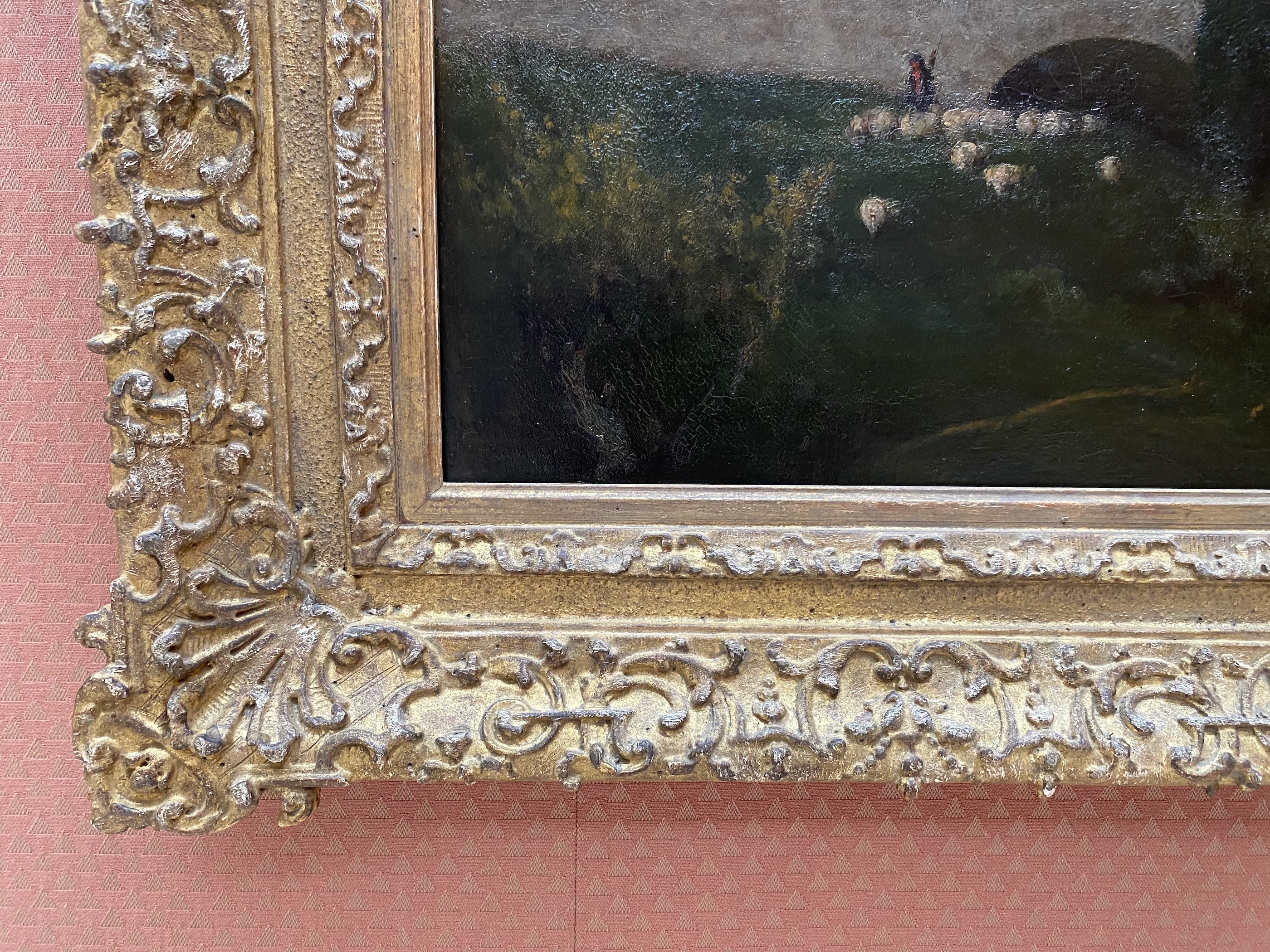
The artist’s approach to this subject is notably soft and atmospheric, typical of his finest work from this period. As the American art scholar Irma B. Jaffe points out, Inness’s Italian paintings of the 1870s reflect both his conversion to Swedenborgianism, a neo-Christian sect which he adopted several years before, and his growing interest in “pictorial science.” The painter strove to flatten space and to treat it more diagrammatically. One sees this in Ariccia in the succession of planar elements--the long bridge in the foreground, the strict alignment of building elevations in the town itself, and the insistent linearity of hills and horizon beyond. This tendency toward abstraction is carried over to details within the composition, too: a herdsman with sheep in the lower left corner is rendered as pure pattern. Inness was not an Impressionist, per se, but Ariccia signals both his attachment to fleeting effects of light as well as his belief in the “science of geometry” and optical realism. This large painting predicts the later, tonalist works where distinctions between foreground and background elements all but vanish in Inness’s oeuvre.
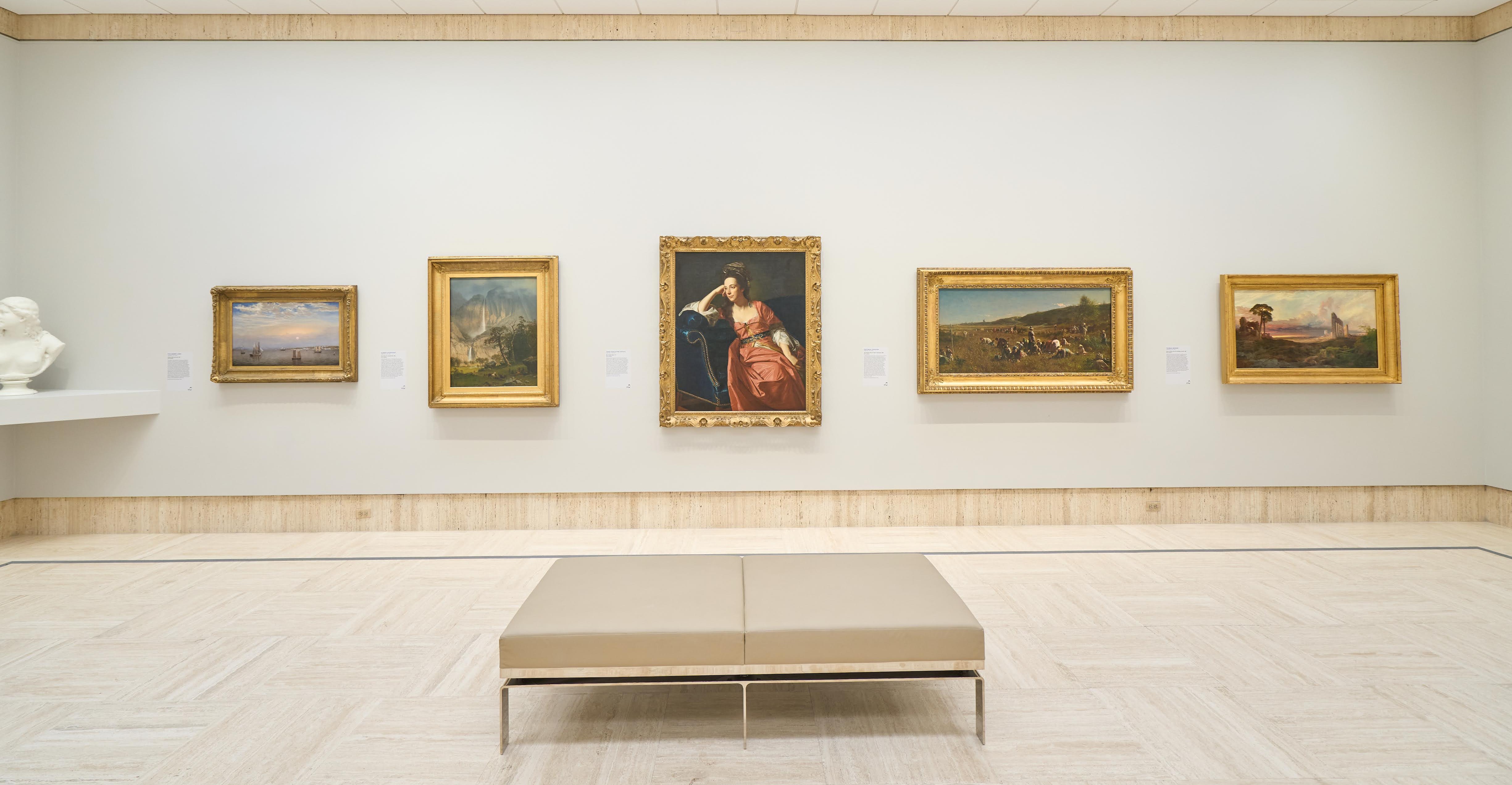
Ariccia was the fourth American painting to enter the Timken Museum of Art. It was acquired in 1972, the very same year as Eastman Johnson’s Cranberry Harvest, Island of Nantucket.





.png)