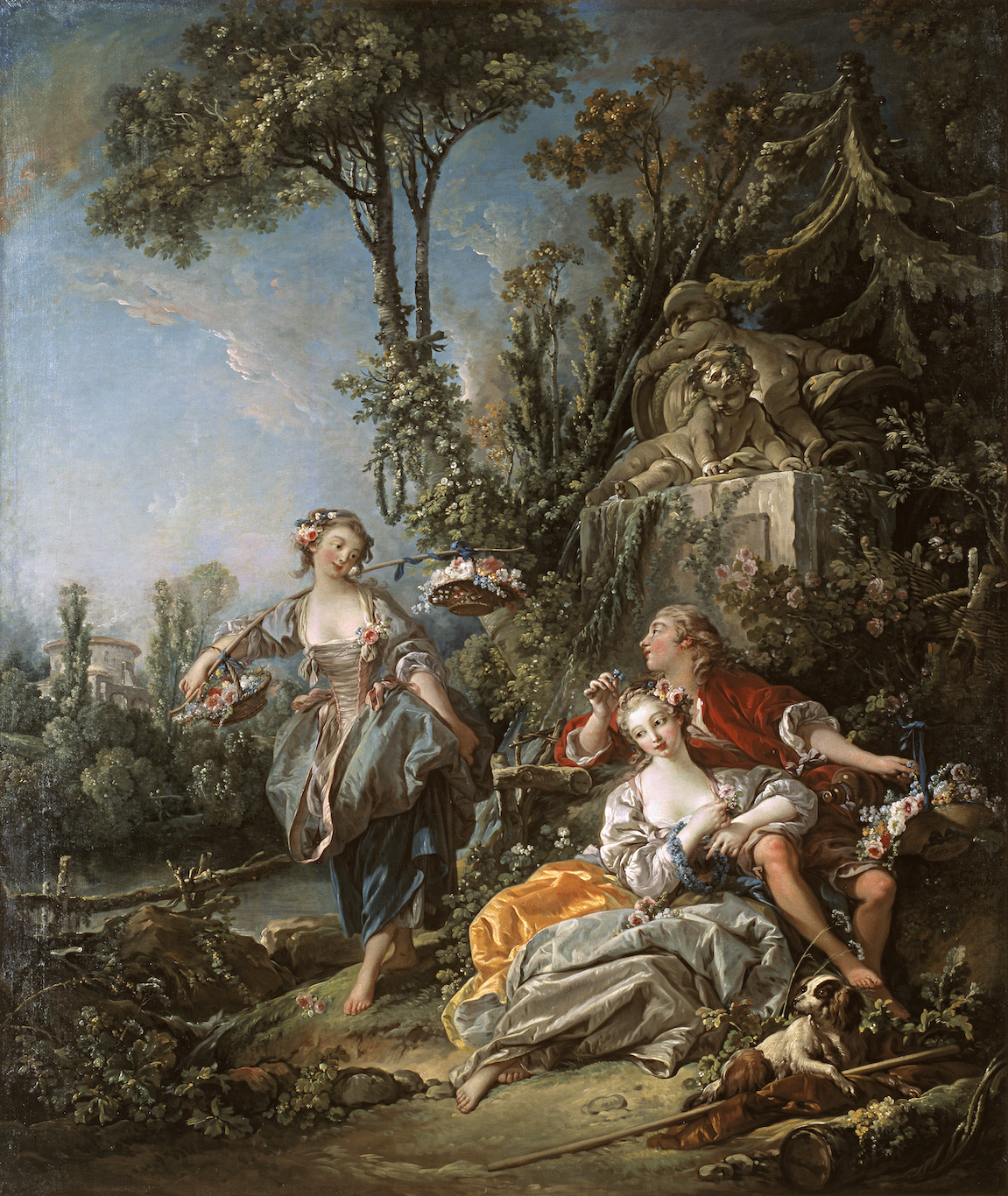
As followers of this blog know, the Timken is temporarily closed. This is due to health concerns related to the pandemic. During this time, we have opted to undertake some critical improvements to our facility. When our museum re-opens to the public in 2021, the visible (and invisible) changes will make all of the forced distance from our collection over the past 40+ weeks seem worthwhile, I predict. About a week ago, however, I was reminded of what is at stake with the objects we steward for the public’s benefit when I encountered the museum’s painting by François Boucher (1703-1770) in storage. The crate that houses this work is enormous. It towered above me like a piece of minimalist sculpture. Outside of its protective container and ornate frame, Boucher’s canvas alone measures roughly 8 feet tall and 6 feet wide. Standing beside the box, I was reminded how this object must travel on its side in order to clear the bronze door jambs at the Timken’s entrance. We are accustomed to thinking about the art of our own time in monumental terms--think of Richard Serra’s rolled steel sculptures or Kara Walker’s theatrical silhouettes-- but in the mid-eighteenth-century, French artists had their own ambitious goals for grabbing attention and making heroic statements with their work.
It happens that Lovers in the Park was already on my mind when I bumped into its crate in storage. At almost the same time, the Timken’s registrar, Katherine Noland, received an inquiry about this picture from a British scholar. The researcher was interested in what we knew about the contents of a nineteenth-century country house that once belonged to the Rothschild family in Buckinghamshire, England. The Rothschilds’ sprawling property, known as Mentmore Towers, was designed by Joseph Paxton, the architect of London’s Crystal Palace, and George Stokes. Descendants of the original owners occupied Mentmore until the 1960s, by which time it had fallen into disrepair (maybe they needed a pandemic to force them into tackling the deferred maintenance), but not before being used to store some of England’s most precious art collections during World War II. The estate was sold in 1978 to The Maharishi Foundation and converted into a meditation/educational center. Subsequent owners tried unsuccessfully to convert the Jacobean-styled mansion into a six-star luxury hotel. Mentmore went back on the real estate market in 2010 with a price tag rumored to be £16 million. The elaborate structure continued to be used as a set for music videos and big budget films, including Batman Begins (2005) where it’s painting-festooned corridors stood in for the fictional haunts of Bruce Wayne.
Would it surprise you to know that Boucher’s picture was once an integral part of this grand country house? Purchased by Baron Mayer Amschel de Rothschild--better known to pals as “Muffy”--in 1851, Lovers in a Park was one of several works that were installed in the so-called “White Drawing Room” at Mentmore. We don’t know why, or for what setting, Boucher painted these works almost a century earlier, but we might presume they once formed an elaborate decorative ensemble in France. This painting and another nearly identically-sized one by Boucher called The Fisherman, 1759 (Hamburger Kunsthalle; https://online-sammlung.hamburger-kunsthalle.de/en/objekt/HK-785/der-angler?term=Boucher&context=default&position=0 ), hung on either side of a grand fireplace in the reception hall immediately to the left of the home’s garden entry. Three tall slender panels--L’Offrande à la Villageoise https://www.nationalgalleries.org/art-and-artists/5694/pastoral-scene-loffrande-%C3%A0-la-villageoise , La Jardinière Endormie https://www.nationalgalleries.org/art-and-artists/5695/pastoral-scene-la-jardini%C3%A8re-endormie , and L’Aimable Pastorale https://www.nationalgalleries.org/art-and-artists/5696/pastoral-scene-laimable-pastorale are all today in Edinburgh and likely hung nearby. Like Lovers in a Park, these works all depict young, happy couples in idyllic settings and remind us of a time when human interaction was a simple, even mindless thing. Scholars believe that they, too, shared walls in Mentmore’s drawing room with our composition and its companion image.
The Rothschilds’ descendant, Albert Edward Harry Meyer Archibald Primrose (not kidding), better known to the world as the 6th Earl of Rosebery, sold Mentmore’s most valuable contents at auction in 1964. Shortly afterwards, Lovers in the Park resurfaced in the London art market. The Putnam Foundation purchased the painting, in 1965, on the advice of Agnes and Elizabeth Mongan, two art historians who frequently advised the Timken’s board on collection matters. Boucher’s painting has scarcely left the building since. We should remember that despite its depiction of carefree idleness, it was once, and has been again lately, a picture on the move. While Boucher’s work will eventually make it back into the Timken’s French gallery, not without difficulty, it can’t be rehung there soon enough for me.





.png)