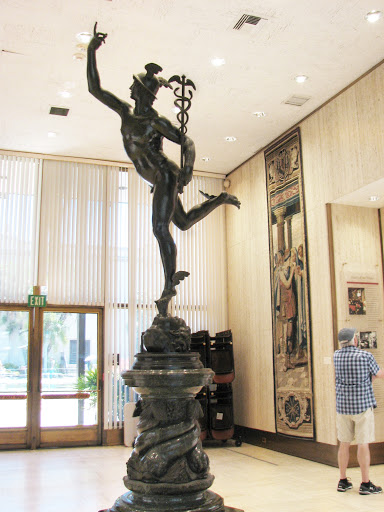
Jean de Boulogne--better known to art history by his nick-name, Giambologna (1529-1608)--was born in Douai, in today’s Northern France, but which was Flanders in the 16th century. He worked for the greatest part of his career in Florence, Italy. It has been suggested that Giambologna’s Medici patrons jealously refused to give him permission to leave the city once he had proven his talents. Indeed, he was widely judged to be the most innovative sculptor among the generation of artists who came of age after Michelangelo Buonarroti (1475-1564). Giambologna’s powerful, intertwined figures in marble and bronze epitomized Mannerist principles as the aesthetic values of his era tipped from pure Renaissance idealization toward heightened Baroque drama.
The Timken has a fine example of Giambologna’s work. Well, sort of. For many years, we displayed a copy of the artist’s Flying Mercury in the museum’s main reception area. An original, sixteenth-century cast of this famous bronze sculpture is now kept at the Bargello in central Florence. Multiple replicas of Mercury are to be found in museums throughout the world. A remarkable, half-sized version is at the Kunsthistorisches Museum in Vienna, for instance, along with more than a dozen other great examples of this artist’s sculpture which were collected by Habsburg connoisseurs. Some of these casts of Mercury are, if not original, quite old. The Timken’s is relatively new. Experts believe that it was likely created during the second-half of the 19th-century, if not later, and most of the folks we’ve consulted have noted that its resemblance to the expertly-finished bronzes that were produced in Giambologna’s time is strained. A distant relation, a gesture toward the noble past--or maybe just a really nice piece of garden decoration--ours is far from a masterpiece in its own right.
How did this work come to be at the Timken, a place that doesn’t have the habit of displaying replicas in its galleries? There is a good answer to that question in the institution’s archives. Walter Ames, the formidable lawyer who helped San Diego mastermind the construction of the Timken building, was a fan of the National Gallery of Art. During one of Ames’s frequent visits to Washington, D.C. in the early 1960s, he paused to admire the NGA’s cast of Mercury. That version was also created significantly later than the original. It likely dates from the 1780’s/1850’s, but had once belonged to Paul Mellon, whose philanthropy helped boost the creation of that institution. “If good enough for Paul Mellon,” Ames may have reasoned, “then it is good enough for the Timken.” A receipt for Mercury exists still in the curatorial records of the Timken, demonstrating that Ames knew exactly what he was acquiring: a very late copy.
A couple of years ago, we removed Flying Mercury from the prominent, centrally-located space it had occupied since the museum’s opening. This decision, it needs to be said, was reached not because it was inauthentic, but because we desperately wanted to create a more welcoming environment for our visitors. A few ardent fans of the sculpture complained about missing it, but those with whom I spoke directly did not understand that this sculpture was a copy, made long after Giambologna’s time. Indeed, most were surprised to learn it was a modern object, not much older than the modern building in which it had been placed. We are in the process of re-siting Flying Mercury in the small, manicured garden located just to the South of our entry corridor. I am confident it will look lovely there, like the sturdy outdoor garden decoration that it was always intended to be.





.png)