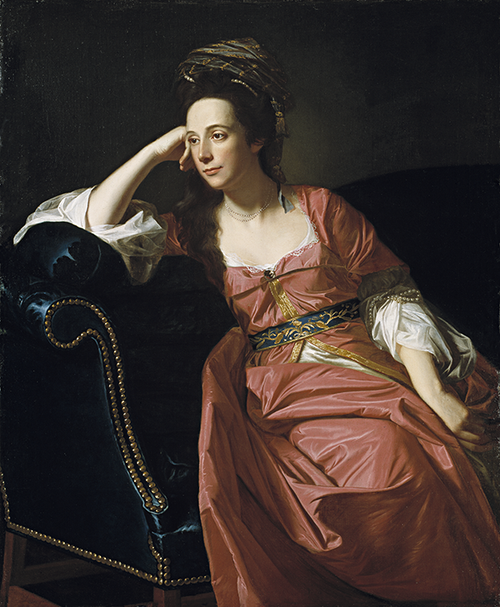
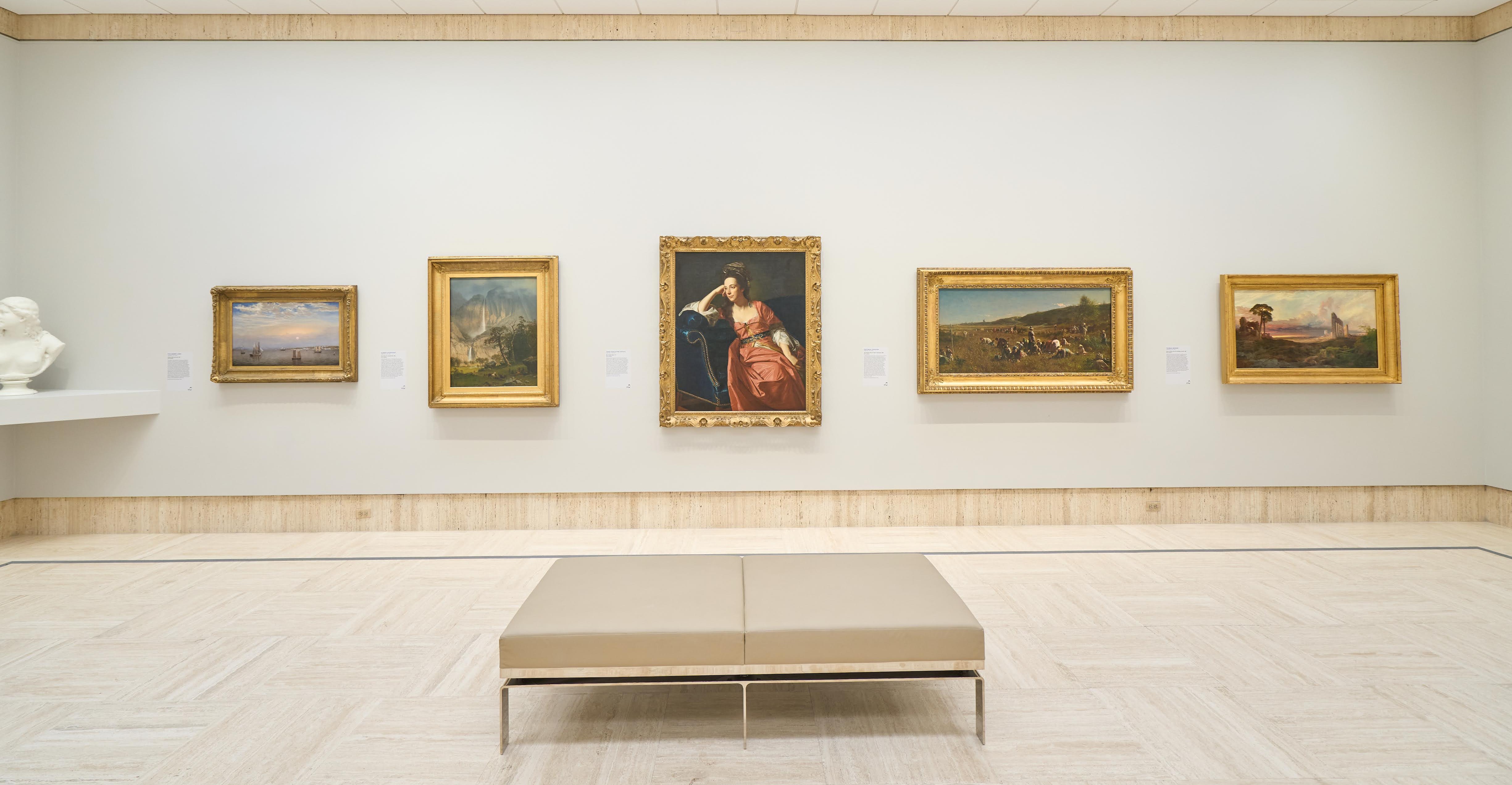
In 1771, Copley left his native Boston for a six-month stay in New York, where he accepted numerous portrait commissions. His first subject was Margaret Kemble Gage, the American-born wife of General Thomas Gage, commander-in-chief of the British forces in North America, who had sat for a portrait by the artist in 1768. Mrs. Gage wears a turban-like swath of drapery, a silk caftan over a lace-trimmed chemise, and an embroidered belt—a Turkish-style costume that enhances her languid pose. Such clothing was fashionable at British fancy dress balls, but since masquerade balls were not held at the time in New York City, Mrs. Gage would have had no occasion to wear the costume outside the studio.
By descent in the Gage family, Firle Place, Sussex, until 1984; Consigned to Thomas Agnew & Sons, London, sale February 24, 1984; Acquired by the Putnam Foundation, 1984
London, Society of Artists of Great Britain, 1772, no. 50, as “A lady; half length”; Liverpool, Walker Art Gallery, 1976-77, American Artists in Europe, 1800-1900, cat. by Edward Morris, p. 16, no, 27; Washington, D.C., National Portrait Gallery, 1987, American Colonial Portraits, 1700-1776, cat. by Richard H. Saunders and Ellen G. Miles, pp. 216, 241-43, 301, no. 77; Museum of Fine Arts, Boston, and The Museum of Fine Arts, Houston, 1995, John Singleton Copley in America, cat. by Carrie Rebora and Paul Staiti et al., pp. 53, 67-68, 88, 105, 232, 266, 286-92, 295, 297, 300, no. 67, fig 59, as Mrs. Thomas Gage (Margaret Kemble).
Henry Pelham to John Singleton Copley, November 17, 1771, London Public Record Office (C05/39); Guernsey Jones, ed., The Letters and Papers of John Singleton Copley and Henry Pelham (Boston, 1914), pp. 114, 117, 174, 192, 197; Frank W. Bayley, The Life and Works of John Singleton Copley (Boston, 1915), p. 111; Barbara Neville Parker and Anne Bolling Wheeler, John Singleton Copley: American Portraits in Oil, Pastel, and Miniature with Biographical Sketches (Boston, 1938), p. 265; Charles Merrill Mount,“ A Hidden Treasure in Britain, Part II: John Singleton Copley,” Art Quarterly 24 (Spring 1961): 33-94; Jules David Prown, John Singleton Copley (Cambridge, Mass., 1966), pp. 60, 79, 80, 89, 214, 387, no. 284; Clifford Musgrave,“ Firle Place, Sussex,” Antiques 97 (February 1970): 260-66; John Russell, “A Portrait of Lady Returns,” New York Times, January 5, 1984; Valerie F. Brooks, “Tender Offer for Plain Jane,” Art News 83 (May 1984): 20; Julian Agnew, “Ideas from Heaven,” in Agnew’s, 1982-1992 (London, 1993), pp. 56-60; Carol Troyen, “John Singleton Copley and the Heroes of the American Revolution,” Antiques 148 (July 1995): 89, pl. VIII; Carrie Rebora and Paul Staiti, “John Singleton Copley in America,” American Art Review 7
(1995): 118-23, ill.
The Timken provides collection images to scholars, educators, publishing companies, commercial entities, and the public. Please review the TERMS GOVERNING REPRODUCTIONS OR PUBLICATION OF IMAGES.
To proceed with your image request, fill out the Image Request Form and email it to registrar@timkenmuseum.org.
For questions please contact info@timkenmuseum.org.
This record has been reviewed by Timken Museum of Art staff and may be incomplete or contain errors. Our records are constantly revised. Inquiries about provenance are advised to contact the Director of Curatorial Affairs: curator@timkenmuseum.org.