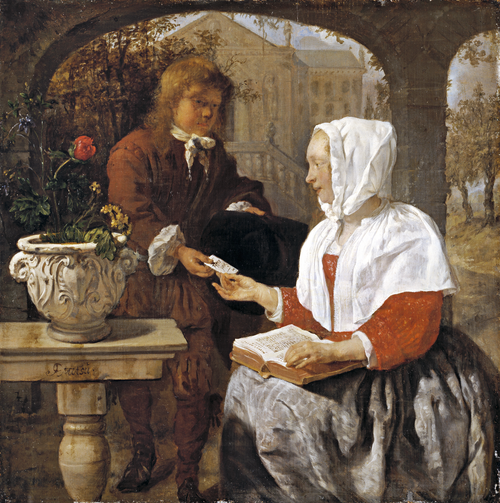
Writing letters became fashionable in Europe in the seventeenth century after the establishment of a postal system. Gabriel Metsu's painting is part of a Dutch tradition of images dealing with the popular subject of the love letter. The young woman, seated in an arcade, receives a letter from a young messenger. Beyond the arcade is a classically styled Palladian villa that conveys elegance and wealth. This panel is the companion to another painting by Metsu, today in the Musée Fabre in France, showing a man writing a letter. The two panels complement one another in size and subject, and the young man and the young woman may be the artist and his wife.
The Dowager Boreel, Amsterdam, her sale (v.d. Schley, Yver, Roos, de Vries), Amsterdam, September 23, 1814, pp. 6–7, lot 8 (950 florins, Van Yperen) [1] Matthias Ignatius van Iperen (dealer), Amsterdam, 1814–(?); King of Sardinia (?) [2]; Mr. Stanley, London, The Catalogue of a Superb Collection of Truly Valuable Dutch and Flemish Cabinet Pictures..., auction cat., June 7, 1815, p. 13, lot 170 (£210, bought in) [3]; Mme. Le Rouge, Paris, her sale, (Laneuville), Paris, April 27, 1818, p. 22, no. 34 (bought in? [4], 5080 francs) [5]; Lambert Jan Nieuwenhuys (dealer), Brussels [6] Auguste-Marie-Raimond, prince of Arenberg, Brussels, by 1829; Duke of Arenberg, Brussels (by inheritance) – 1958 [7]; Wildenstein & Co., New York; Acquired by the Putnam Foundation, 1958 [8]
Brussels, Ducal Palace, 1855; Düsseldorf, 1904, Kunsthistorische Ausstelling. Katalogue, cat. by Firmenich-Richartz, p. 143, no. 341; Cambridge, Mass. , Fogg Art Museum, extended loan, 1960-65; The Hague, Mauritshuis, and The Fine Arts Museums of San Francisco,
Great Dutch Paintings from America, 1990, pp. 330-33, no. 42 (San Francisco only).
Charles Spruyt, Lithographies d'apres les principaux tableaux de la collection de A. S. Monsigneur le Prince Auguste d'Arenberg avec le
catalogue descriptif (Brussels, 1829), p. 10, no. 54; Catalogue et description des tableaux qui fonnent la collection de S.A.S. le Prince August d'Arenberg (Brussels, 1833); John Smith, A Catalogue Raisonńe of the Works of the Most Eminent Dutch, Flemish, and French Painters, 9 vols. (London, 1829-42), 4:95, 96, no. 70; W. Bürger [Théophile-Etienne- Joseph Thoré], Galerie d'Arenberg il Bruxelles (Brussels, 1859), pp. 140-41, no. 36; Auguste Marguillier, "L'Exposition des maîtres anciens à Düsseldorf," Gazette des Beaux-Arts 32 (1904): 284; C. Hofstede de Groot, A Catalogue Raisonné of the Works of the Most Eminent Dutch Painters of the Seventeenth Century, 8 vols. (London, 1908-27), 1:310-11, no.183 (cf. nos. 24, 262); Edouard Plietzsch, 1 'Gabriel Metsu," Pantheon 17 (January 1936): 5, ill.; Agnes Mongan and Eliza- beth Mongan, European Paintings in the Timken Art Gallery (San Diego, 1969), pp. 72, 73, 123-24, no. 26, ill; Franklin W. Robinson, Gabriel Metsu (New York, 1974), pp. 39-40,41, 6o, 81, fig. 76, frontispiece; Timken Art Gallery: European and American Works of Art in the Putnam Foundation Collection (San Diego, 1983), pp. 62-63, 121, no. 22, ill.; Franklin W. Robinson, Gabriel Metsu: The Letter (San Diego, 1985).
The Timken provides collection images to scholars, educators, publishing companies, commercial entities, and the public. Please review the TERMS GOVERNING REPRODUCTIONS OR PUBLICATION OF IMAGES.
To proceed with your image request, fill out the Image Request Form and email it to registrar@timkenmuseum.org.
For questions please contact info@timkenmuseum.org.
This record has been reviewed by Timken Museum of Art staff and may be incomplete or contain errors. Our records are constantly revised. Inquiries about provenance are advised to contact the Director of Curatorial Affairs: curator@timkenmuseum.org.