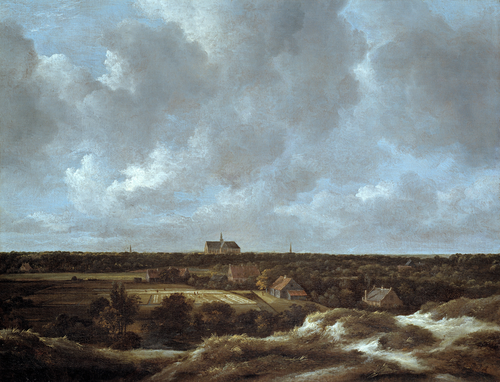
Haarlem linen had a great reputation in the seventeenth century and the linen industry was enormously important to the city's economy. Clothing and uncut cloth were bleached in the fields around the city in a process that took several months. Jacob van Ruisdael, one of the most important seventeenth-century Dutch landscape painters, completed about fifteen views of Haarlem showing the linen-bleaching fields. In this richly textured canvas, as in other landscapes of the subject, the artist arranges the buildings and rows of linen to lead the eye diagonally through alternating areas of shadow and light. On the horizon is Saint Bavo's, a famous church flanked to the east and west by bell towers, where Ruisdael was buried in 1682.
Count Paul Stroganoff Museum, St. Petersburg, by 1864 [1]; Stroganoff Museum, Leningrad, 1928 [2]; Stroganoff Collection sale, Berlin (Lepke), no. 74, ill. (DM60,000) May 12–13, 1931 [3]; Professor Kocher, Bern; Mlle Maurer, La Tour-de-Peilz, Switzerland Knoedler, New York, 1954; Acquired by the Putnam Foundation, 1954 [4]
Provenance Notes:
[1] G. F. Waagen (Die Gemäldesammlung in der Kaiserlichen Eremitage zu St. Petersburg: nebst Bemerkungen über andere dortige Kunstsammlungen [Munich, 1846; 2nd ed. St. Petersburg, 1870], pp. 412–13); Petr Petrovich Semenov-Tian-Shanskii (Études sur les peintres des écoles hollandaise, flamande et néerlandaise qu’ on trouve dans la collection Smenov [sic] et les autres collections publiques et privées de St. Petersburg [St. Petersburg, 1906], p. cxvi, note 2)
[2] Jakob Rosenberg (Jacob van Ruisdael [Berlin, 1928], p. 75, no. 50)
[3] Price per auction catalog annotation, Getty Research Institute copy.
[4] June 3, 1954, As noted by the Art Loss Register and others, inclusion in the famous Soviet-sponsored 1931 Stroganoff sale is hardly a guarantee of Stroganoff family provenance. However, thanks to Seymour Slive (Jacob van Ruisdael: A Complete Catalogue of his Paintings, Drawings, and Etchings [New Haven, 2001], pp. 89–90, no.64, ill.), we can now definitively place this painting in the Stroganoff collection from 1864 onward. We can safely assume that it remained there until its appearance in the 1931 auction at Lepke. There is nothing to disrupt the apparent continuity of Swiss ownership through the 1930s and 1940s.
A claim regarding this painting, and a number of others in the Timken collection, was presented in 2004 by an attorney representing members of the Oppenheimer family. Although the family lost a number of works to Nazi looting, none of the Oppenheimer paintings, which were sold in early 1935 in a Nazi-sanctioned auction, correspond to pieces owned by the Timken.
New York, The Metropolitan Museum of Art, extended loan, 1956-65.
Jakob Rosenberg, Jacob van Ruisdael (Berlin, 1928), p. 75, no. 50; "Countrywide Loans from California,"Art News 55 (November 1956): 33, ill; Agnes Mongan and Elizabeth Mongan, European Paintings in the Timken Art Gallery (San Diego,1969), pp. 70, 71, 123, no. 25, ill.;Timken Art Gallery: European and American Works of Art in the Putnam Foundation Collection (San Diego,1983), pp. 74-75, 123, no. 28, ill.
The Timken provides collection images to scholars, educators, publishing companies, commercial entities, and the public. Please review the TERMS GOVERNING REPRODUCTIONS OR PUBLICATION OF IMAGES.
To proceed with your image request, fill out the Image Request Form and email it to registrar@timkenmuseum.org.
For questions please contact info@timkenmuseum.org.
This record has been reviewed by Timken Museum of Art staff and may be incomplete or contain errors. Our records are constantly revised. Inquiries about provenance are advised to contact the Director of Curatorial Affairs: curator@timkenmuseum.org.